
Exosome IP explained: The global patent landscape and key trends
Exosomes represent a new frontier of cell therapy by offering the biological potency of cells, without the regulatory, manufacturing, and safety burdens that come with using living products. The appeal of EVs lies in the combination of their innate biocompatibility and versatility to be genetically engineered to carry therapeutic payloads or express surface receptors for precision applications. For these reasons, exosomes are increasingly being explored across diagnostics, drug delivery and precision medicine sectors. With patent filings increasing, securing commercially useful patent claims and navigating freedom-to-operate risk are key issues for exosome IP strategy.
For EV innovators, the key IP question is no longer whether the field is promising, but where protectable value now sits in an increasingly crowded and technically complex landscape. This three-part article series, 'Exosomes: Patents, Patentability and Commercial Strategy', will explore those issues from a practical IP perspective, beginning with an overview of the global EV market, patent landscape, and key filing trends. For simplicity and to reflect the interchangeable terminology used in non-commercial settings, this article series refers to both exosomes and extracellular vesicles (EV) while focusing on the commercially and scientifically dominant exosome subclass.
The global exosome market and patent landscape
Exosomes have emerged as an area of increasing scientific, clinical and commercial interest, supported by sustained growth in EV research over the past two decades. Although the field remains in its early stages, with no FDA-approved exosome products to date; increasing patent filings and investment activity indicate that specialist EV start-ups, biotechnology and pharmaceutical companies, and research groups are seeking to secure positions in this developing technology landscape.
The global EV market is currently valued at an estimated US$500–800 million and is projected to reach US$2.7 billion by 20311. In the US alone, between US$500 million and US$1 billion in disclosed capital has been invested in developing core EV technologies over this period, with individual companies raising more than US$300 million across venture rounds2. Some companies have further secured partnership deals with pharmaceutical companies such as Eli Lilly, Takeda and Jazz with aggregate potential deal values in the multi-billion-dollar range3. Geographically, North America currently holds the largest market share at 48%, while the Asia-Pacific market is increasing at a compound annual growth rate of approximately 25–30%4. Collectively, rising investment, projected market growth and major partnership deals highlight the growing commercial interest in, and potential value of EV technologies.
In terms of the volume of patent filings, the leading jurisdictions include China and the US, followed by Europe, Japan and South Korea. While prior to 2014 less than 100 patent filings were recorded, there are now over 1,500 patent families, including 600-800 exosome-specific families5. Similarly, more than 200 EV-based products were under evaluation in clinical trials by 2025 (as registered on ClinicalTrials.gov)6, reflecting substantial investment in EV research and commercial development over the past 5-10 years.
Within the EV market, the leading segments are EV-related kits and reagents (45% of the product market), non-coding RNA carried by or associated with EVs (35% of the biomolecule market), mesenchymal stem cell-derived EVs (45% of the cell-type market), and EV-based diagnostic technologies (62% of the application market). Over the next five years, the strongest projected growth is expected in EV-related services and software (40% CAGR), downstream EV analysis technologies (39% CAGR), EV-associated proteins and peptides (36% CAGR), EV-based therapeutics (40% CAGR), and platelet-derived EVs (31% CAGR)7.
As the field has moved from early platform development toward more defined products, applications and clinical programs, the EV patent landscape has also become more targeted. Earlier filings tended to pursue broad patent claims directed to production, isolation, and scale-up platforms, including bioreactors and host cell engineering. More recent filings increasingly focus on engineered or functional EVs (e.g. cargo loading and surface modifications), specific compositions, and defined therapeutic, diagnostic, or cosmetic applications.
How exosome IP portfolios are typically structured
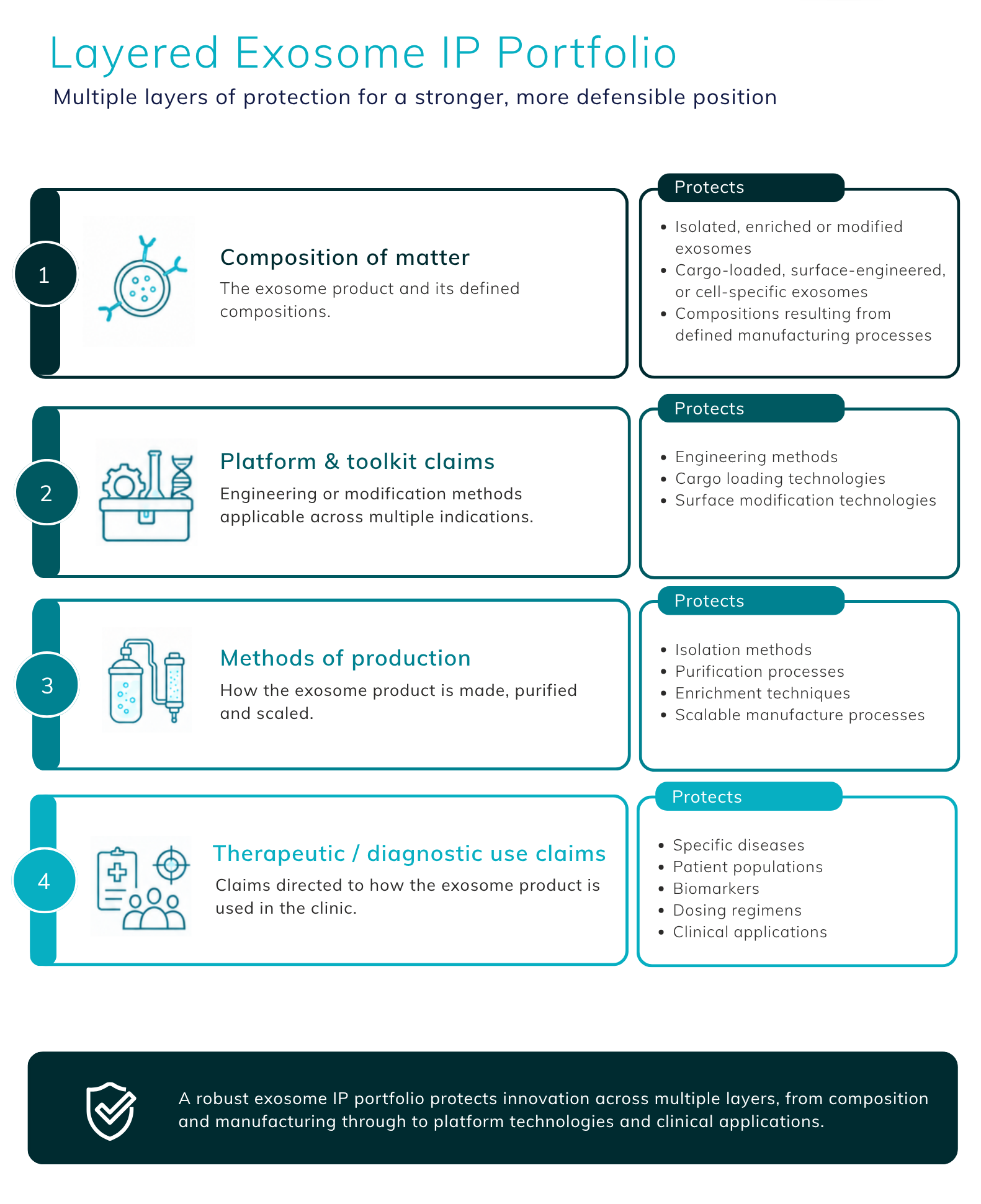
The EV patent landscape has matured quickly, with companies increasingly building layered IP portfolios rather than relying on one or a few, foundational patents. These portfolios typically include claims directed to platform technologies, compositions of matter, manufacturing processes, potency or characterisation assays, and specific therapeutic or diagnostic uses. The objective is to protect the product from multiple angles, while balancing breadth, enforceability, and eligibility risk.
This layered approach also reflects the practical realities imposed by regulators such as the FDA. Purified exosomes, conditioned media and isolated secretome fractions are generally treated as distinct biological products, each requiring their own evidence of identity, purity, potency, safety, efficacy and manufacturing consistency. In practice, this means that commercially important innovations may lie not only within the EV product itself, but also in how it is manufactured, purified, characterised, and clinically used.
For that reason, a robust EV portfolio seeks to protect not just the underlying commercial product, but additionally downstream innovations such as manufacturing processes, potency assays, defined compositions and clinical uses. Manufacturing developments may also give rise to EV compositions that can themselves be claimed as novel compositions of matter. This makes a layered portfolio particularly important: early filings help protect the sponsor’s lead product, while later filings having more focused, and narrower claims covering defined technical features of these downstream innovations create defensive coverage around the technical and regulatory pathways that follow-on innovators may need to navigate.
Strategic IP considerations for exosome innovators
Exosome technologies present significant opportunities, but also unique IP risks, particularly around patentability and portfolio strategy. Despite the growth and strong market interest, regulatory hurdles continue to delay clinical adoption of EV products, with no EV therapeutics currently on the market. However, the growing number of products entering clinical development suggests the field is moving towards a critical regulatory inflection point. Crucially, effective patent strategy can leverage these regulatory hurdles to secure commercially useful claims and secure a defensible IP position for companies in this nascent but emerging space.
Our life sciences team works closely with companies, research institutes, and universities to develop patent strategies that protect the underlying science and position it for successful capital raising and partnering.
Looking ahead: Where this series will go next
Part 2 of this series will explore the eligibility issues surrounding patenting exosomes and how they are being navigated and addressed in practice, followed by Part 3 which will explore commercialisation risks, freedom to operate, and the practical task of identifying “clear air” where companies can still develop, differentiate, and protect valuable new EV inventions.
Footnotes
Exosomes Market Size, Trends & Industry 2031 Report, Mordor Intelligence, 2026 (accessible at: Exosomes Market Size, Trends & Industry 2031 Report)
Top 4 Most Richly Funded Exosome Startups in the World, BioInformant, 2024 (Accessible at: Top 4 Most Richly Funded Exosome Startups in the World)
Transaction in the Exosome field – NurExone Pre-Clinical Data, NurExone Biologic Inc (Accessible at: Transaction in the Exosome filed - NurExone Pre-Clinical Data)
Exosomes Market Size, Trends & Industry 2031 Report, Mordor Intelligence, 2026 (accessible at: Exosomes Market Size, Trends & Industry 2031 Report)
Exosomes Patent Landscape Case Study By Joshua Beverley, Beverley, 2024 (Accessible at: Exosomes Patent Landscape Case Study By Joshua Beverley)
The global clinical landscape of human-derived extracellular vesicles, Wei et al., 2026 (Accessible at: The global clinical landscape of human-derived extracellular vesicles: an analysis based on ClinicalTrials.gov (2010–2025) | Clinical and Experimental Medicine | Springer Nature Link)
Exosomes Market Size, Trends & Industry 2031 Report, Mordor Intelligence, 2026 (accessible at: Exosomes Market Size, Trends & Industry 2031 Report)